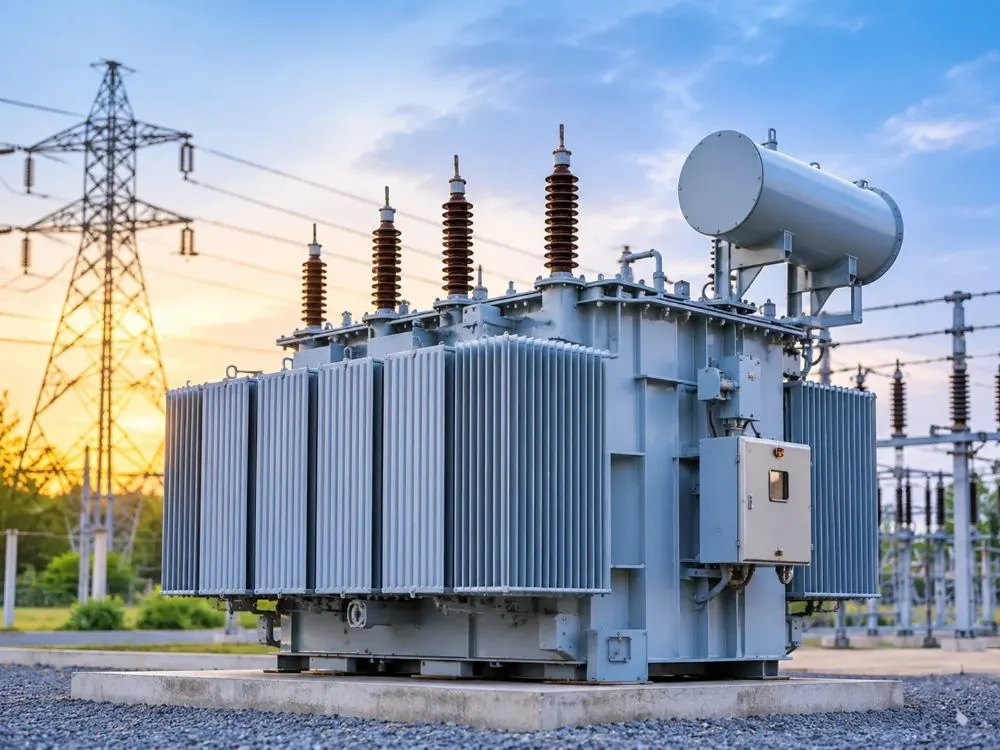
Electricity passes through an intricate network until it reaches homes, offices, factories, and other commercial buildings. Nevertheless, the voltage that is used for the long-distance transmission of electricity is not suitable for direct use by consumers. Therefore, distribution transformers play a critical role in reducing medium-voltage electricity to an appropriate voltage level.
However, selection of a transformer depends on a number of considerations such as installation, loading conditions, applications, environmental factors, cooling arrangement, and efficiency among others. Knowledge about different distribution transformer types can be helpful in choosing suitable equipment for a particular project.
Here we will discuss types and applications of distribution transformers.
1. Oil-Insulated Distribution Transformer
An oil-insulated transformer uses the insulating oil to provide electrical insulation as well as cooling.
- The oil acts as a medium to absorb the heat produced due to the operation of the transformer and dissipate it to the transformer casing and the atmosphere.
They are extensively used in the distribution of electricity owing to their capacity to withstand heavy loading and suitability for outdoor application.
Typical application areas include:
- Residential colonies and housing projects.
- Industrial plants and manufacturing units.
- Shopping and commercial complexes.
- Electrical utility substations and electrical distribution networks.
Based on the design, the oil-insulated transformers may have hermetically sealed or conservator design.
2. Hermetically Sealed Distribution Transformers
Hermetically sealed transformers are designed in such a way that the tank is completely sealed, and there is no contact between insulating oil and atmosphere.
This design helps keep moisture from entering and contamination of the insulating oil to a minimum.
Being small-sized and having fewer maintenance needs, these transformers are well suited to distribution systems where reliable operation is crucial.
The applications for such transformers are:
- Power distribution in cities and private dwellings.
- Commercial premises.
- Open-air utility installation.
- Infrastructure construction projects.
Such transformers are especially advantageous when it comes to limiting the maintenance needs.
3. Conservator-Type Distribution Transformers
Conservator-type transformers have an extra tank for insulating oil, which is used to accommodate its expansion and contraction due to changing temperatures.
This conservator tank provides space for changing volumes of oil as the transformer gets heated and cooled.
The most common applications of such transformers are:
- Power distribution in industry.
- Utility sub-stations.
- Large commercial premises.
- Infrastructure and utility projects.
4. Dry-Type Distribution Transformers
In contrast to oil-immersed transformers, dry transformers do not employ transformer oil. Instead, they make use of solid insulation systems. Due to the absence of transformer oil, there is no danger of oil leakage.
The dry type is usually employed in situations where indoor installation, fire safety, and environmental conditions need to be taken into consideration.
Applications of this type of transformer:
- Hospitals/health care centers.
- Commercial buildings.
- Industrial buildings.
- Metro stations.
- Infrastructure facilities.
5. Three-Phase Distribution Transformers
Three-phase distribution transformers have been developed for use in three-phase power distribution systems. These transformers are usually applied where there are high demands and balanced loads.
Such transformers play an important role in modern electrical distribution systems.
Applications of this type of transformer:
- Manufacturing industry.
- Commercial buildings.
- Residential development.
- Utility power distribution system.
- Solar energy projects.
Uses of Distribution Transformers in Various Sectors
Distribution transformers are used in almost all sectors which use electricity. The residential sector requires transformers for power consumption, while the industrial sector uses them for providing power to machinery or equipment used in manufacturing. The commercial sector also relies on voltage supply from distribution transformers for various electrical systems.
Also, the renewable energy sector relies on specialised transformer applications for power distribution and transmission.
Some of the specifications to keep in mind when selecting an electrical distribution transformer include its rated capacity, voltage class, winding material, cooling method, power loss, insulation, and testing requirements.
How to Select a Distribution Transformer
Look beyond rated capacity and cost when choosing a transformer for any project. The transformer’s design and construction need to comply with the electrical load, environmental condition, installation process, and IS/IEC standard for the transformer.
Tecksons (Trans Power Solutions) produces distribution transformers with maximum ratings of 5 MVA and voltage up to 33 kV. The product range includes hermetically sealed and conservator-type transformers having copper or aluminium windings and ONAN cooling. It is easy to choose equipment suited to your operation after knowing the different types of distribution transformers available.
Disclaimer: This article is for informational purposes only and provides general guidance about distribution transformers, their applications, and selection considerations. Readers should verify product specifications and suitability with the manufacturer or a qualified electrical professional before making any purchasing, installation, or technical decisions.
Frequently Asked Questions
The main types include oil-insulated, hermetically sealed, conservator-type, dry-type, and three-phase distribution transformers.
A distribution transformer reduces medium-voltage electricity to a suitable voltage level for homes, commercial buildings, industries, and other consumers.
Oil-insulated transformers use insulating oil for cooling and insulation, while dry-type transformers use solid insulation and do not contain transformer oil.
They are used in residential areas, industrial plants, commercial buildings, utility substations, infrastructure projects, and renewable energy systems.
Consider the required capacity, voltage, load conditions, installation environment, cooling method, efficiency, insulation, and applicable IS/IEC standards.
Informative article that clearly explains distribution transformer types and applications.