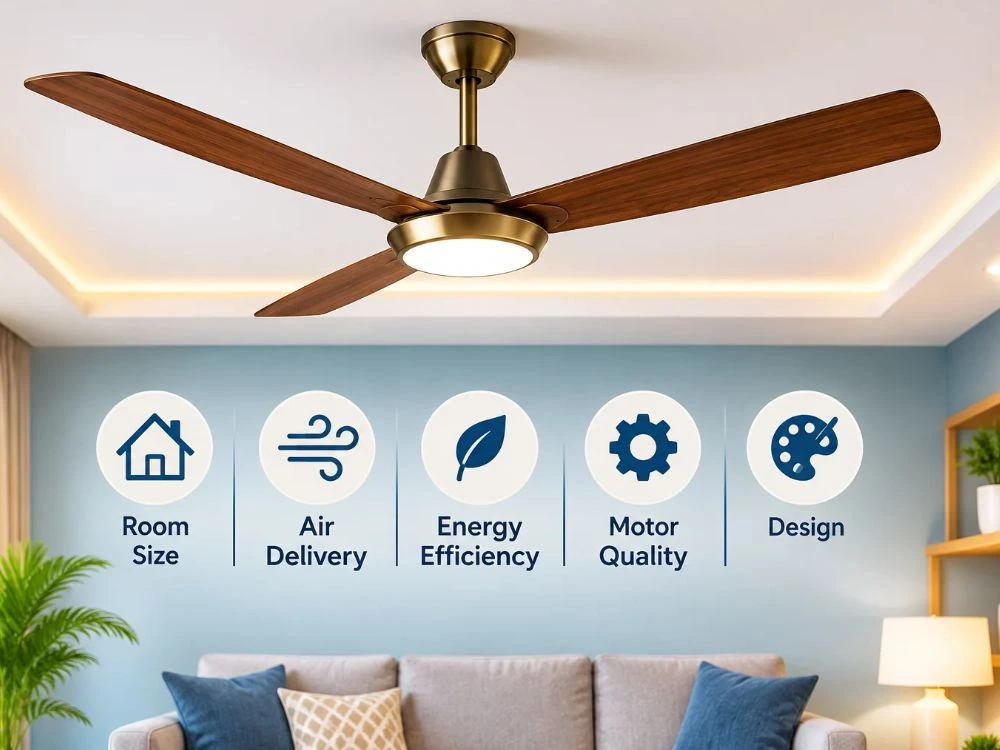
Ceiling fans are one of the most commonly used household items in India. Depending on whether you want to escape from the summer heat or ensure good ventilation in any season, you will certainly benefit from having a ceiling fan in your home. But selecting the appropriate device goes beyond design and pricing comparison. There are many factors that should be considered to choose the best ceiling fan for home.
1. Pick the Right Size
The dimensions of the room play an important role. An insufficiently sized fan will not provide proper air circulation, whereas an oversized one will create too much airflow in a small room.
The recommended ceiling fan size depends on the square footage of the room:
- Small rooms up to 100 sq. ft.: 900 mm sweep.
- Medium-sized rooms 100–150 sq. ft.: 1050-1200 mm sweep.
- Large rooms 150-250 sq. ft.: 1200-1400 mm sweep.
- Very large rooms: Think of installing several fans depending on room layout.
It is just a general recommendation. The height of the room, location of the furniture and other aspects might also affect the decision.
2. Ceiling Fan Speed and Air Delivery
Most consumers pay attention to the revolution per minute (RPM) of a fan. But having high RPM does not necessarily translate into effective circulation. Blade efficiency, motor capacity, and air delivery are other factors that make up an efficient fan.
In looking at ceiling fan speed, take note of the number of speed settings and air delivery information. Air delivery, measured in cubic meters per minute (CMM), is an important aspect that indicates the air flow of the fan.
An adequately powered fan with adjustable speed settings would provide a comfortable environment without needing to run at full speed.
3. Energy Consumption
Electricity usage is an equally important factor, especially if you will be using the fan regularly throughout the day.
- BLDC and conventional motor fans have differences in energy usage.
- BLDC fans use less electricity compared to induction motor fans, depending on their specifications.
Before buying any fan, check the star rating on the Bureau of Energy Efficiency (BEE). The star rating on the label of a fan reflects its energy efficiency, according to the testing standards in use.
4. Choose a Fan Based on the Room
The ventilation needs of different rooms vary.
When buying a ceiling fan for bedroom, you should go for a model that is silent and allows speed adjustment. Other convenient features include remote control and sleep timer.
If you are choosing a ceiling fan for living room, especially in an open plan layout, consider blade sweep and airflow, as well as the number of seats.
When buying a fan for your kitchen, among others, small rooms, consider your ceiling clearance and ventilation needs.
5. Evaluate the Motor Quality and Durability
The motor of a ceiling fan determines how long the fan lasts and performs. It is important to look at motor construction and quality of winding. Blade material and balancing, as well as the internal components of the fan, matter too.
Also look out for BIS certification and manufacturer specifications of the product, as well as warranty period. Proper balancing of the blades minimises vibration and unnecessary noise.
Cleaning and maintenance enhance durability.
6. Do Not Neglect the Design and Installation
The ceiling fan is a utility item; however, it is also important because it affects the design of your interior. Select a finishing that will match your furniture, ceiling and lighting.
Before installation, it is necessary to ensure the strength of the ceiling and its mounting, as well as to estimate the distance between the walls and other devices. Proper mounting will guarantee the correct airflow.
Conclusion
To find the best ceiling fan for household purposes, it is necessary to consider all the aspects: comfort, efficiency, size, durability and design. Instead of the choice of a certain design or price, you need to study the technical characteristics of the product.
Disclaimer: This content is published for informational purposes and may contain views, opinions, or claims of the guest author. Marketing Beat does not necessarily endorse or guarantee the accuracy of the products, services, recommendations, or statements mentioned in this article.
Frequently Asked Questions
Choose the fan size based on your room’s square footage. Larger rooms generally require a larger blade sweep for effective air circulation.
Air delivery indicates the amount of air a fan circulates, usually measured in cubic meters per minute (CMM). Higher air delivery can provide better airflow.
Yes, BLDC fans generally consume less electricity than conventional induction-motor fans, depending on their specifications.
Consider room size, air delivery, energy consumption, motor quality, durability, design, and installation requirements.
A bedroom fan should ideally offer quiet operation, adjustable speeds, and convenient features such as remote control or a sleep timer.